First received 20 October 2026. Published online 23 November 2026.
Jooya Wong (https://orcid.org/0009-0008-1275-2935), Chongqing College of Mobile Communication, China and UCSI University, Malaysia ([email protected]; [email protected])
Abstract:
Web3 projects offer new arrangements for scholarly publishing, yet platform labels reveal little about which scholarly functions change. We examine 18 cases retained from 43 candidates through qualitative comparative document analysis, distinguishing documented mechanisms, reported plans, and evidence of operation. The recurring pattern is functional unbundling: research objects, versions, reviews, rewards, and selected decisions acquire distinct records and procedures that can be combined in different ways. Content addressing and version links alter what can be identified; review bounties separate remuneration from publication; governance mechanisms specify particular decision domains. This modular vision predates Web3. The study identifies concrete technical and economic mechanisms through which parts of that vision are being implemented, alongside non-Web3 comparisons and evidence-limited cases. It contributes an empirical account of modular scholarly communication at the level of objects and functions. Documented designs and bounded operational traces support this interpretation, while sustained use, scholarly recognition, and maintenance remain questions for future research.
Keywords: decentralized science; scholarly publishing; functional unbundling; modular scholarly communication; research objects; Web3
1. Introduction
Web3 scholarly publishing is reopening the question of what counts as a unit of scholarly communication. The journal article provides a familiar package through which a research narrative, supporting materials, editorial assessment, author credit, and distribution reach a scholarly audience. These elements already have partially separate lives in repositories, software archives, and preprint services, but the article commonly remains the point around which they are assembled and evaluated. Current decentralized science projects make that relationship newly visible. A content identifier can specify a file independently of its hosting location; a decentralized persistent identifier can link versions of a research object; a review can have its own record and payment condition; a repository proposal can leave a decision trace. Vukolov et al. (2024) describe a decentralized persistent identifier (dPID) architecture that links versions of manuscripts, datasets, and code within a research object. Ants Review specifies a protocol in which review records are submitted and an approver authorizes a bounty payment, while ResearchHub offers ResearchCoin bounties for accepted peer reviews (Ants-Review, n.d.; ResearchHub, n.d.). These examples locate the interventions at different points in the research process. Their coexistence raises an empirical puzzle. Is the significant change associated with Web3 occurring at the level of the publishing organization, or in the smaller objects and functions through which scholarly communication is performed? An answer requires examining what these arrangements actually specify, how they connect, and what evidence exists of their use.
This question belongs to a longer debate about the organization of scholarly communication. Priem and Hemminger (2012) argued that journal functions could be decoupled to permit changes in individual services. Hartgerink (2019) subsequently developed a design for communicating research as linked modules, including text, data, and code. Scholarship beyond the paper also involves the recognition of outputs that cannot be adequately represented by a narrative article alone (Priem, 2013). Work on integrated research objects and Findable, Accessible, Interoperable, and Reusable (FAIR) research software has made the relations among narrative, computation, and supporting materials more explicit (DuPre et al., 2022; Barker et al., 2022). These developments establish both the promise and the burden of comparison for Web3 publishing. Separately identifiable outputs, open review, and modular services have substantial precedents. A study of decentralized science (DeSci) therefore needs to identify the additional implementation choices offered by its projects and distinguish those choices from the broader reform agenda they share. The relevant change might concern the way a record is verified, how a contribution is linked to a reward, or which decision is made programmable. Whether such changes improve research communication depends on how they work within scholarly practices, including the practices that make data meaningful and reusable (Borgman, 2015).
Blockchain-for-science research has supplied an extensive repertoire of possible arrangements. Early contributions envisaged distributed records across the research cycle, decentralized publication workflows, and continuous review supported by cryptoeconomic incentives (Bartling & Fecher, 2016; Coelho & Brandão, 2019; Stojmenova Duh et al., 2019). These contributions differ in technical specificity, and subsequent work has moved beyond broad proposals. Tenorio-Fornés et al. (2021) implemented and evaluated prototypes of an interoperable review ecosystem; Anderson et al. (2025) designed and assessed a token system for reviewer incentives. A systematic review also organizes the growing blockchain peer-review literature and identifies continuing implementation challenges (Morales-Alarcón et al., 2024). Alongside these design studies, DeSci has become an object of definitional and empirical research: Weidener and Spreckelsen (2024) examine its values and principles, while Díaz et al. (2025) investigate organizational structures, technologies, and funding across 49 organizations. The remaining gap is thus more specific than an absence of research on DeSci. Definitions describe shared ambitions; ecosystem studies describe organizations; prototypes establish the feasibility and perceived usefulness of particular designs. None of these units alone provides a consistent account of which scholarly function a mechanism changes across heterogeneous projects. A platform can publish a detailed token model while leaving its storage arrangements unspecified, or operate a journal while describing additional services as future plans. Reading every feature through the platform’s overall label would erase this variation. Cross-case comparison needs to connect the scholarly function, the specified mechanism, and the strength and temporal scope of its evidence.
We ask: what new capabilities does decentralized infrastructure introduce into scholarly publishing? The study addresses this question through qualitative comparative document analysis of 18 cases retained from a pool of 43 candidates, using a research corpus with 72 evidence entries and 40 source records. The scope includes journals and publishing platforms alongside services that make research outputs identifiable, accessible, assessable, or attributable. Funding, governance, and code infrastructures enter through these connections to scholarly communication. Across the better-documented cases, the clearest recurring pattern is functional unbundling: selected objects and activities become separately addressable, recordable, rewardable, or governable. This is an interpretive finding about configurations in the corpus, supported by comparisons among specific mechanisms and by cases that limit their attribution to Web3. Our contribution is an empirical account of how a longstanding modular vision is instantiated through content addressing, linked identifiers, object-related review, programmable rewards, and bounded decision procedures. It also identifies where a proposed module remains weakly documented or where operational evidence is narrower than the design. This perspective makes the contribution of decentralized publishing assessable at the level at which change is actually specified.
2. Literature Review
2.1 Unbundling Scholarly Communication
The intellectual foundations of modular scholarly communication precede Web3. Priem and Hemminger’s (2012) decoupling argument targets the organizational coupling of archiving, registration, dissemination, and certification within journals. When access to one service depends on accepting the entire bundle, local innovations have limited room to develop. Their proposed separation makes it possible to imagine different providers and procedures for functions that are ordinarily encountered together. The analytical value of this argument lies in distinguishing the continuing purposes of scholarly communication from the organizations that package them. Its limitation for the present inquiry is also productive: a proposal to separate services leaves open which technical records will connect those services and how researchers will use them. Counting decentralized journals would preserve the very organizational unit that the decoupling argument invites us to examine. A functional comparison instead asks whether a particular intervention creates a separable operation and how that operation remains connected to the research it concerns. Hartgerink (2019) takes modularity into the representation of the research process itself. His Dat-based design treats researcher-defined modules as communicable units and links them to preserve provenance. Registration, distribution, certification, archiving, and incentivization provide the functional frame. This is a particularly close antecedent because it combines a modular communication proposal with a peer-to-peer technical design. It also prevents a simple chronology in which conventional open science supplied only ideals and Web3 subsequently supplied all the technology: distributed and cryptographically verified approaches were already part of the modular literature. The comparison therefore concerns particular implementations, including their continuity and limitations, rather than a general technological first. A common vocabulary can obscure different commitments. Separating a review service from a journal changes who supplies a function; publishing an independently identified research module changes the object on which services act. These dimensions can coincide, but neither implies the other. The present analysis keeps both in view: separable functions and separately represented objects.
The expansion of scholarly outputs adds a further distinction between decomposition and useful integration. Priem’s (2013) account of scholarship beyond the paper challenges the article’s dominance as the recognized output. DuPre et al. (2022), however, show why additional links alone are an incomplete response: integrated research objects should support interaction among narrative, data, code, and computational environments. Their discussion of modular infrastructure makes openness of interfaces and practical reexecution central concerns. The FAIR principles likewise address the conditions for finding and reusing research materials (Wilkinson et al., 2016), while FAIR for Research Software adapts those concerns to software as a distinct output (Barker et al., 2022). These contributions expose a tension within modularity. Finer units may make contributions more visible, yet the meaning and usability of each unit often depend on relations to other materials. A collection of independently identified files can remain difficult to interpret or reproduce. Thus granularity should be examined through both the boundaries that identify components and the relations that make them intelligible.
Recent infrastructure work makes this tension concrete. Bauer et al. (2026) examine DataPLANT (Data in PLANT research), a German consortium developing research-data infrastructure for plant sciences, and its services for FAIR Digital Objects. These services connect structured research contexts, versioning, workflow integration, and data publication. Such work provides an external comparison for Web3 claims: granular, versioned, citable objects are also being developed through open research infrastructures outside the DeSci frame. Modularity is therefore an insufficient criterion for technological distinctiveness. The sharper question concerns how a specific arrangement establishes an address, records an interaction, or connects a contribution to a rule for action. Content-derived identifiers, ledger records, and programmable token transfers offer different implementation choices, but their value must be assessed against comparable scholarly functions. This shifts the literature gap from a contest over who originated modularity to an empirical comparison of mechanisms and their evidential support.
2.2 Web3 and DeSci Publishing
Early blockchain-for-science literature sets a broad expectation against which current mechanisms can be examined. Bartling and Fecher’s (2016) vision extends blockchain records across attribution, data processing, publication, evaluation, incentives, and funding. Its scope helps explain why DeSci includes services far beyond journals, although the document’s prospective claims supply no adoption measure. Coelho and Brandão (2019) describe a decentralized publishing model with roles and workflows, bringing the ambition closer to the organization of publication. Stojmenova Duh et al. (2019) develop a blockchain platform design in which modifiable publications, continuous review, and incentives are connected. Together, these works make decentralized scholarly communication technically and organizationally conceivable. They also raise a demanding question for empirical research: which parts of such architectures have become identifiable arrangements outside the proposal that introduces them? The existence of a design is an intellectual and technical contribution; its use in routine scholarly work is a separate object of investigation.
Later design research provides stronger evidence within more bounded settings. Tenorio-Fornés et al. (2021) combine blockchain and the InterPlanetary File System (IPFS) in an open peer-review ecosystem, implement proof-of-concept and minimum viable product prototypes, and evaluate technical and user-facing aspects. Their treatment of interoperability already involves a hybrid architecture. This is a useful corrective to descriptions that equate decentralized review with moving every component onto a blockchain. Anderson et al. (2025) further advance incentive research through design science, combining literature and interview inputs with artifact development, cost analysis, survey evaluation, and qualitative interviews. These studies justify taking proposed mechanisms seriously as evaluated designs. Their findings still answer different questions from long-term participation, repeated use across disciplines, or sustainable platform operation. The distinction is methodological: prototype evaluation can examine feasibility and user responses, while durable scholarly adoption requires evidence over time. A cross-case document study can locate these different forms of evidence, but cannot substitute for either evaluation design. The synthesis by Morales-Alarcón et al. (2024) identifies recurring concerns with transparency, incentives, reputation, security, and smart contracts in blockchain peer review. It also calls for further real-world and longitudinal assessment. The literature consequently offers a substantial repertoire of design claims alongside uneven evidence about implementation and impact. A limitation of comparing projects through promised benefits such as trust or transparency is that these terms can refer to quite different operations. Publishing a review, timestamping its hash, verifying its author, rewarding its completion, and evaluating its scientific adequacy each make a different contribution. They can be combined, but support for one does not transfer automatically to the others. Functional analysis can clarify this ambiguity by specifying what is recorded, who can act, and what the mechanism actually controls. It also allows positive findings to remain precise: a documented payment condition is an observable advance in incentive design even when its effect on review quality remains an open question.
DeSci’s developing empirical literature offers another necessary level of comparison. Weidener and Spreckelsen (2024) derive a definition and guiding principles from an exploratory review and expert survey, emphasizing participation, ownership, governance, and incentives. These field-level ideals explain the breadth of the movement without establishing compliance by individual projects. Díaz et al. (2025) analyze survey responses from 49 organizations and report substantial variation in technologies, funding, and organizational form, including the limited presence of decentralized autonomous organization (DAO) governance features. Their ecosystem study demonstrates why organizational diversity deserves investigation. Our analysis extends the level of resolution to scholarly functions: an organization categorized as a DAO may govern funding without governing manuscript acceptance, while a platform without DAO governance may still implement a content-addressed publication mechanism. The unresolved empirical task is to connect these functions to concrete procedures, distinguish specified designs from attributed claims, and identify the operational traces available for each. Functional unbundling is the interpretation to be examined through that comparison, rather than an attribute assigned to all DeSci organizations in advance.
3. Data and Methods
The study uses qualitative comparative document analysis. The case is a project, platform, protocol, or venue; the object of comparison is a mechanism within scholarly communication. This design accommodates different organizational forms and materials while asking a common question about the function performed. It is not set-theoretic Qualitative Comparative Analysis: no truth table, causal configuration model, or composite decentralization score is constructed.
The database contains 43 candidates discovered through DeSci directories, ecosystem lists, scholarly sources, and web searches, including the Awesome DeSci directory (DeSciWorldDAO, n.d.). The screening process retained 18 cases for the present study and recorded reasons for not including 25. Intended criteria were relevance to scholarly communication, accessible official or sufficient archived or independent documentation, and at least two codable architecture variables. Funding-only or advocacy roles, insufficient documentation, and inaccessible sites informed exclusions. This was purposive selection, not a census. The retained register includes evidence-limited boundary cases: CureDAO and Aimedis lack verified scholarly-publishing mechanisms in the corpus, and OpenAccess DAO is represented by an academic account of plans without an identified official site. They remain visible but contribute no affirmative mechanism findings. Seeds of Science provides a non-Web3 comparison; sci2sci and GOSH retain evidence of changed organizational direction. Table 1 preserves recorded status labels, which do not certify operation of every function.
Table 1. Included cases
| Project | Primary role | Recorded status |
|---|---|---|
| DeSci Labs / DeSci Nodes | Publishing platform | Active |
| ResearchHub | Publishing platform | Active |
| ROSA Journal / Science Asset | Journal | Active |
| Orvium | Publishing platform | Active |
| NobleBlocks | Journal | Active |
| Ants Review | Peer review | Inactive |
| First Approval | Research data | Active |
| Seeds of Science | Journal | Pivoted |
| SCINET | Funding | Active |
| OpSci | Infrastructure | Active |
| bloxberg | Infrastructure | Active |
| JocelynDAO | Governance | Active |
| sci2sci | Other (Data governance software as a service) | Pivoted |
| GOSH | Infrastructure | Pivoted |
| OpenAccess DAO * | Repository | Unknown |
| CureDAO * | Research data | Active |
| Aimedis * | Research data | Active |
| Molecule | Funding | Active |
Note. Status is retained from the database at 19 October 2026. * Evidence-limited cases; inclusion and Active status do not certify a scholarly mechanism or its operation.
The empirical corpus comprises the database, 72 evidence entries, 40 source records, the screening codebook, research logs, analytical notes, and two locally retained PDFs. Evidence entries carry an access date of 19 October 2026, the analytical cutoff, while source documents span earlier years. Official documentation, repositories, and publication artifacts provide the primary mechanism evidence; scholarly and registry sources supply corroboration. Directories support discovery, and promotional or third-party accounts support attributed claims unless more specific evidence is available. The scholarly literature reviewed above provides interpretive context and is additional to the 40 empirical source records.
Table 2. Study design
| Element | Design |
|---|---|
| Candidate pool | 43 projects; directory and ecosystem discovery followed by source inspection. |
| Retained cases | 18 cases; 25 not included. Evidence-limited and pivoted cases remain visible. |
| Materials | 72 evidence entries; 40 source records; official pages, repositories, scholarly sources, two local PDFs, logs and notes. |
| Source hierarchy | Official mechanisms first; scholarly or registry corroboration; directories for discovery; press for attributed claims. |
| Core dimensions | Storage; identity and identification; validation; governance; incentives. Publication units and interoperability cut across them. |
| Time cutoff | 19 October 2026; earlier documents retained with their historical context. |
| Evidence distinction | Documented design; reported-only claim or plan; operational evidence assessed separately. Unknown is not No. |
| Analytical approach | Qualitative cross-case matrices and negative cases; no composite score or causal estimation. |
Coding follows the codebook’s functional dimensions, frozen after eight pilot cases. Each categorical field is read with its detailed notes and evidence excerpts. Documented evidence specifies a technical component or a procedure connecting actors, objects, and actions. Reported-only evidence describes a claim, plan, or arrangement without sufficient specification or corroboration. Operational evidence records use, such as a published artifact or dated bounty, and is assessed separately from documented design. A product page or project-wide Active label cannot establish operation of every component. Figure 2 retains this distinction at mechanism level: D marks documented mechanisms, R marks reported or insufficiently corroborated entries, and white marks not documented, including unknowns. Identity and object identification are separate columns. Unknown, Undisclosed, and Unclear remain evidence gaps; no blank cell establishes absence.
Cross-case comparison links specified operations to the objects and functions they affect, then examines variation and counterexamples. The coding dimensions remain unchanged; the Results synthesize them into three findings about addressable objects, separable validation and incentives, and bounded governance. Figure 1 represents the resulting analytical contrast. Its interoperability labels refer to Digital Object Identifiers (DOIs), Open Researcher and Contributor IDs (ORCID iDs), and International Standard Serial Numbers (ISSNs), which identify research outputs, researchers, and serial publications, respectively. Seeds of Science tests whether community review requires Web3; Ants Review separates detailed design from ongoing service; funding and code infrastructures test the boundaries of publishing functions. Variables with extensive missingness, including versioning, rights, open source, and registration-agency interoperability, support case-specific analysis rather than sample-wide prevalence estimates. The retained materials do not document independent duplicate coding or inter-coder agreement, and neither is claimed. The study compares documented configurations, without estimating causal effects on quality, cost, or adoption.
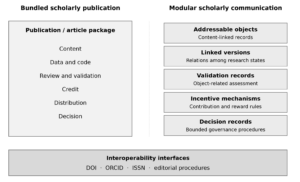
Figure 1. From bundled publishing to modular scholarly communication
4. Results
The comparison reveals a recurring separation between the publication package and the operations performed on its components. Objects can acquire content-linked records, review can acquire a distinct payment procedure, and decisions can be specified for a bounded domain. These patterns recur unevenly and through different technical arrangements. Table 3 retains the underlying functional comparison; Figure 2 shows where specific mechanisms are documented or only reported across the retained cases.
Table 3. Core mechanisms by layer
| Layer | Specified capability and cases | Evidential boundary |
|---|---|---|
| Storage | Content addressing and version links (DeSci Labs); issue distribution (ROSA); anchoring (Orvium, Ants Review, bloxberg). | Addressability and record integrity do not guarantee continuing availability. |
| Identity and identification | ORCID-linked attribution; wallet-mediated access; CIDs and dPIDs for objects; on-chain repository and asset records. | Person identity, control of a key, and identification of an object are different functions. |
| Validation | Review remuneration (ResearchHub, Ants Review, NobleBlocks); object-linked dialogue (DeSci Labs); community review (Seeds of Science). | A specified procedure or historical practice does not establish current use or superior review quality. |
| Governance | Snapshot-linked governance (ResearchHub); token voting proposals (NobleBlocks); DAO repository procedures (GOSH). | The object of a decision and who can participate must be established separately. |
| Incentives | Review remuneration; non-fungible token (NFT)-linked funding; proposed co-authorship access; author revenue sharing. | Funding, publication fees, and rewards for scholarly labor are not interchangeable. |
4.1 Addressable Scholarly Objects
The clearest technical pattern concerns the units to which records attach. DeSci Labs’ dPID architecture connects a resolvable research-object identifier to content identifiers and linked versions. The design combines IPFS and InterPlanetary Linked Data (IPLD), a Sidetree-based identifier layer, a decentralized identifier (DID) schema, and blockchain anchoring of a root content identifier; Ceramic supports lookup in the described implementation (Vukolov et al., 2024). This makes version relations part of the object’s metadata structure. ROSA’s first issue gives the contrast a concrete publication form: its masthead includes an IPFS content identifier (CID) and an InterPlanetary Name System (IPNS) key alongside conventional publishing information (Science Asset, 2024). Here the identified unit is an issue. Ants Review specifies IPFS storage for requirements and review texts, with Ethereum timestamping of hashes, while Orvium describes optional blockchain anchoring for publication records (Ants-Review, n.d.; Orvium, n.d.). Across these cases, a similar vocabulary of verification refers to different objects: a linked research object, an issue, a review, or an anchored record. Their common contribution is the ability to refer to a particular digital state independently of a general platform description. The scope of that state determines what can subsequently be checked or linked.
Addressability also extends beyond publication files. GOSH’s technical documentation describes on-chain repository operations and DAO procedures around code collaboration (GOSH, n.d.). A repository action can therefore become a recorded component of a research-related process. Molecule’s official repository specifies intellectual property non-fungible token (IP-NFT) contracts and associated tokenization components, making a research-related asset separately identifiable and transferable within that design (Molecule, n.d.). These are different operations from publishing a research account: the token record organizes an asset relationship, while repository records organize code and contributions. Person attribution follows another path. DeSci Labs, ResearchHub, ROSA, and Orvium connect contributors to ORCID, whereas wallet or Ethereum Name Service (ENS) arrangements appear elsewhere in the sample. ROSA also permits pseudonymous submission through contact with the editor (Science Asset, n.d.). The resulting configuration separates the identity of content, the identity of an actor, and the record of a contribution. That separation is a positive architectural finding because each relation can be specified without treating an address, a person, and a scientific output as interchangeable.
The evidence is strongest for the dPID design, the identifiers printed in ROSA’s issue, and specified repository or protocol operations. These sources support distinct levels of inference: a technical implementation, a published artifact, and a documented procedure. First Approval’s announcement of decentralized storage, NobleBlocks’ on-chain publication claims, and SCINET’s publication descriptions remain less specific in the retained materials. Molecule’s IPFS and encryption description comes from a third-party summary, so it remains reported evidence in the map; earlier accounts of GOSH contribution tokens likewise provide weaker support than its repository documentation. None of these weaker entries is needed to establish the comparison among specified objects. The demonstrated result is an expanded set of addressable records and linkages; continuing retrieval and routine scholarly use require further evidence.
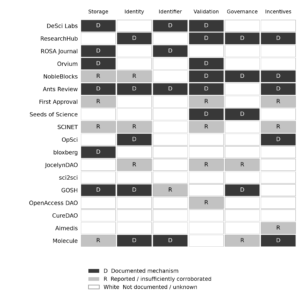
Figure 2. Project–mechanism map
Note. D = documented mechanism; R = reported or insufficiently corroborated, including plans; white = not documented / unknown. D denotes a specified design or procedure, not proof of current operation. Columns cover distributed storage/anchoring; wallet or ENS access/identity; content or on-chain object identifiers; open, tokenized or community validation; token, on-chain or community decisions; token/NFT incentives. Conventional mechanisms and non-token incentives are discussed in the text.
4.2 Separable Validation and Incentives
Review appears as a contribution with its own visibility, timing, and compensation rules. ResearchHub’s recorded bounty page offers US\$150 in ResearchCoin for an accepted review and requires a completed profile with ORCID authentication (ResearchHub, n.d.). The arrangement identifies the scholarly act, the eligibility condition, and the reward. DeSci Labs takes a different route: claiming a validation badge initiates public dialogue with referees around a deposited research object (DeSci Labs, n.d.). Evaluation can consequently develop after deposit and attach to that object. Ants Review specifies another combination: an issuer establishes a bounty and requirements, a reviewer submits a review hash, and an approver authorizes payment; the protocol also provides for refunds of unfulfilled bounties (Ants-Review, n.d.). Comparing these procedures reveals several independent design choices. The timing of evaluation, public visibility of its record, conditions for payment, and authority to approve a contribution can be specified separately. The reward mechanism makes review labor explicit while retaining a procedure for judging whether the work satisfies the request.
NobleBlocks’ official tokenomics allocates token uses to publishing fees and editor or reviewer compensation (NobleBlocks, n.d.). That design establishes a connection between a token and scholarly labor, unlike token presence alone. Orvium separately describes open and single-blind review with controls over reviewer and review visibility (Orvium, n.d.). Seeds of Science provides a useful non-Web3 comparison: its journal used community voting and commenting before closing in February 2025, and its subsequent publishing model includes subscription-revenue sharing with featured authors (Seeds of Science, n.d.). First Approval proposes exchanging data access for co-authorship on resulting articles (First Approval, 2023). These arrangements reveal that review openness, contributor reward, and author credit can be changed through different means. The Web3-specific contribution is located in the particular record or payment mechanism, while the broader effort to recognize scholarly labor also proceeds through non-token arrangements.
This comparison also separates remuneration from financing. OpSci’s project cards record Ether (ETH) fundraising and NFT-related impact prices; SCINET describes cryptocurrency funding flows; Molecule specifies asset tokenization (OpSci, n.d.; SCINET, n.d.; Molecule, n.d.). These mechanisms concern participation in funding or research-related assets. A fee for publication, an investment in research, and payment for an accepted review perform different functions even when they use similar tokens. Classifying them together would obscure the finding: the strongest incentive evidence connects a specified contribution to an explicit reward condition. That connection makes the incentive inspectable as part of a scholarly process.
Operational support varies. ResearchHub’s dated bounty is evidence of an offered procedure in use; it is not a transaction audit of completed payments. Ants Review provides detailed design and historical prototype evidence, with no recent development recorded in the corpus. NobleBlocks’ compensation rules are documented, whereas its claims about immutable review records are less substantiated. First Approval’s data review remains a plan in the retained announcement, and OpenAccess DAO’s proposed review platform remains evidence-limited. Seeds of Science documents a historical practice. These distinctions bound the finding to separable procedures and specific operational traces, without assigning common maturity or measured review-quality gains to the cases.
4.3 Recorded Decisions and Modular Governance
Governance becomes analytically clearer when the decision domain is specified. ResearchHub’s Foundation describes oversight of community governance, the token, and editorial programs, while its documentation links a Snapshot space (ResearchHub Foundation, n.d.; ResearchHub, n.d.). NobleBlocks specifies token-holder voting on platform upgrades and grant proposals (NobleBlocks, n.d.). GOSH documents DAO procedures associated with repositories and proposals (GOSH, n.d.). These arrangements concern different decisions: coordination of a platform, allocation of funding, and management of code collaboration. The recurring capability is to make selected procedures explicit and recordable, with programmability where contracts or repository operations specify execution. It is possible to identify the object of governance without assuming that all authority within the organization has the same form.
The boundaries between decisions are consequential for scholarly publishing. An Ants Review approver authorizes a reward under a specified protocol; this role is distinct from community governance over the protocol itself. A vote on a grant determines resource allocation, while manuscript acceptance requires an assessment of a submission. JocelynDAO’s stated use of blockchain records for governance points toward procedural transparency, although the retained account gives less detail about participation and enforcement (JocelynDAO, n.d.). bloxberg offers a complementary institutional observation: its history records an association formed in 2022 and dissolved in October 2024, followed by renewed strategic responsibility at the Max Planck Society and a council structure (bloxberg, n.d.). The allocation of organizational responsibility can change while technical record-making continues. The case therefore reinforces the need to identify what a governance mechanism governs, rather than reading its scope from the presence of a blockchain.
The available evidence establishes documented rules and organizational arrangements more consistently than actual participation or execution. Snapshot links do not measure voting activity, and grant-voting specifications do not show that token holders decide publication acceptance. JocelynDAO remains a reported governance entry in Figure 2; the name OpenAccess DAO supplies no additional mechanism evidence. Across the stronger cases, the result is bounded modular governance: selected decisions acquire a specified procedure and record, with the distribution and exercise of decision rights remaining questions tied to each domain.
5. Discussion
5.1 From Bundled Publishing to Modular Scholarly Communication
The evidence supports a modular view of decentralized scholarly publishing. Its clearest recurring pattern is functional unbundling: selected components of scholarly communication acquire records and procedures that can be organized separately from the publication package. This interpretation responds directly to the gap between platform-level descriptions and function-level evidence. Priem and Hemminger (2012) made the separation of journal services an explicit reform agenda, while Hartgerink (2019) located modularity in linked units of research communication. The cases examined here show how those two concerns meet in particular implementations. A versioned research object specifies the material to which a later evaluation can refer; a review bounty distinguishes the work of evaluation from the event of publication; a repository proposal identifies a decision about a contribution. The empirical contribution lies in mapping these concrete forms of separation and connection across projects with different purposes and evidential depth. The pattern also revises what should count as a meaningful comparison. A journal that adds a content-addressed distribution route and a review protocol that links payment to approval need not be ranked on a single scale of decentralization. They alter different parts of the communication process. Their value can be assessed by identifying the object, the operation, the responsible actor, and the interfaces required to connect the result to scholarly practice. Functional unbundling, understood this way, supplies a more discriminating account of change than a distinction between conventional and decentralized platforms. It permits a positive claim about specific capabilities without requiring every component to be redesigned together. The empirical cases support this configuration-level interpretation, even where their operational histories differ substantially.
Unbundling is also compatible with continued aggregation. Researchers still need coherent accounts of a study, and journals can remain useful venues for selecting, interpreting, and communicating those accounts. A module is valuable when it can be acted upon separately and related back to the work it concerns. Fragmenting a study into many poorly connected records would defeat that purpose. The cases suggest an analytical distinction between separability and composability: a review with its own payment rule is separable, while combining that review record with a versioned object and a contributor profile requires additional interfaces. The corpus contains partial combinations, not a common end-to-end modular system. Its recurring pattern therefore describes an emerging repertoire of arrangements rather than a completed transition. This is also why the non-Web3 cases matter. Seeds of Science shows that a community can redesign assessment without blockchain, while conventional identifier services already connect distinct outputs. The contribution attributed to Web3 must remain at the level of its particular implementation choices.
5.2 Addressability and the Granularity of Scholarship
Granularity concerns what can receive a distinct identity and become the target of an action: an issue, a file version, a dataset, a review, a repository change, or a research-related asset. Addressability provides a technical basis for distinguishing these units, and linking establishes relations among them. This extends the discussion initiated by Priem (2013) while preserving its historical lesson: data and software already had scholarly significance before DeSci. FAIR for Research Software gives software-specific guidance on making such outputs findable and reusable (Barker et al., 2022). The dPID and repository cases offer mechanisms through which some of these objects and their changing states can be represented. Their significance is strongest where an otherwise ambiguous action becomes more precise, for example when a review can refer to a particular version or a contribution record can point to a specific repository operation. The technical record then helps identify what was contributed or assessed.
Addressability and scientific intelligibility nevertheless develop through different forms of work. DuPre et al. (2022) emphasize interaction among the components of integrated research objects; Bauer et al. (2026) connect FAIR Digital Objects to structured metadata and research workflows. Read alongside the cases, these accounts suggest that smaller units become useful through richer relationships, not simply through multiplication of identifiers. A CID can support checking that retrieved content matches the addressed content. Understanding how that content was produced still requires relevant methods, context, and provenance relations. The dPID case is instructive because its linked metadata structure does work beyond the hash alone. By contrast, the identifier of a tokenized research asset answers a question about the asset record; interpreting the associated scientific work requires access to its substantive description. This comparison helps locate the contribution of cryptographic and programmable mechanisms without treating every independently recorded item as an equivalent scholarly output. The analytical advance is to examine both the scale of the unit and the kind of relationship the mechanism preserves.
This view also sharpens future evaluation. A useful comparison would examine whether researchers can locate the exact materials associated with a claim, trace changes between versions, and reuse a component outside its original platform. Those are observable consequences of granularity and linking. They are more informative than counting the number of records created. The present corpus identifies designs that make such tests possible, but it does not establish that finer records already receive greater recognition or yield more reproducible research.
5.3 Validation and Incentives as Detachable Functions
Review increasingly appears in these designs as an addressable and rewardable contribution in its own right. The term detachable captures the ability to specify its record, timing, and remuneration separately, while maintaining a relation to the work evaluated. Open-review scholarship has already separated dimensions such as identity disclosure, visibility of reports, and participation (Ross-Hellauer, 2017), and the broader review-innovation literature documents diverse organizational possibilities (Tennant et al., 2017). The Web3 cases add concrete combinations of record-making and payment conditions to that repertoire. A public review can remain unpaid; a token reward can depend on approval by an editor or designated actor; a review can concern a deposited object without immediately becoming a journal acceptance decision. These combinations make a substantive analytical point: the visibility of evaluation, compensation for performing it, and authority to certify a publication are distinct design variables. Treating tokenized review as a single replacement model would hide the choices that the empirical cases make visible.
This finding helps connect design research to the comparative evidence. Tenorio-Fornés et al. (2021) investigate an interoperable ecosystem for review, and Anderson et al. (2025) examine how token incentives can be designed and evaluated. The present cases locate related operations in publicly documented projects: specifying the requested contribution, attaching a reward, recording a submitted review, and assigning an approving role. The systematic review by Morales-Alarcón et al. (2024) provides a wider account of the design concerns to which these operations respond. Together, the literature and cases support a research agenda in which incentive design is evaluated separately from the entire publication system. An incentive can reduce an uncompensated burden for a reviewer while leaving scientific standards and editorial responsibility to other procedures. It can also introduce new selection pressures. Whether reviewers choose particular topics, whether payment conditions encourage useful criticism, and whether disciplinary communities recognize the resulting work are empirical questions that require observation of behavior, not inference from a token specification. The same reasoning clarifies why funding and asset tokenization should remain separate from remuneration for evaluation. A reward for completing a review targets labor; an investment targets a research opportunity or associated asset; author-revenue sharing targets dissemination or readership. Each establishes a different relation between contribution and return. First Approval’s proposed exchange of data access for co-authorship raises a further question about how an access transaction corresponds to substantive contribution and disciplinary authorship norms. Such contrasts strengthen the central claim: modularization expands the set of arrangements that can be combined, while their scholarly legitimacy depends on the action being recognized and the rules governing recognition. The constructive opportunity is to make those rules explicit and testable.
5.4 Composability, Maintenance, and Interoperability
A repository can examine content verification, a journal can adopt a review-record service, and a community can test a payment rule without first replacing every other component. This is an implication of the configurations observed here, not a measured reduction in deployment cost. Every additional module also creates an interface that must be maintained: content has to remain retrievable, identifiers have to resolve, identities and permissions have to be mapped, and records have to retain their meaning across services. Star and Ruhleder’s (1996) relational account of infrastructure helps explain why an isolated technical capability becomes infrastructure through its connection to practice. Ants Review’s detailed but inactive protocol makes that distinction visible. A design can remain inspectable after development has ceased, while use as an ordinary scholarly service requires continuing technical and organizational support.
Persistence provides a precise example. IPFS documentation explains that retained or pinned content and the arrangements supporting storage are necessary for continuing availability (IPFS, n.d.). A content identifier therefore supports a different assurance from a preservation commitment. Persistent identifiers have a similarly infrastructural context. Meadows et al. (2019) describe how identifiers connect people, organizations, and outputs through research-information infrastructure. Crossref’s (2026) position paper, a policy document rather than a peer-reviewed study, emphasizes the interdependence of identifiers, linked metadata, services, and sustainable governance. Applied to the cases, these sources suggest that DOI, ORCID, and ISSN connections can serve as interoperability interfaces. A DOI can support discovery and citation while a CID identifies content; ORCID can connect a contribution to a researcher while a wallet controls an action. Editorial procedures can evaluate a scientific claim whose digital record is secured by a separate mechanism. Their coexistence is a practical configuration to assess on its functions and interfaces.
The resulting evaluation questions concern continuity across those interfaces: Can another service retrieve the object if the originating platform closes? Does a review remain linked to the version it assessed? Who can correct mistaken attribution or resolve a disputed reward? The cases make these questions concrete without supplying a common answer. They also identify a limit to the evidence base. Public documentation varies in depth and can favor articulate or surviving projects; the retained boundary cases constrain claims about the sample as a uniformly verified set. Some status assignments rely on product pages or reachability, and the corpus contains no user study, uptime audit, payment audit, or independent comparison of review quality. A dated artifact or offered bounty is useful operational evidence, but it covers a narrower interval and activity than sustainable adoption. The modular interpretation is therefore strongest as an account of documented arrangements and selected traces of use. Its next test is whether those arrangements can be maintained, combined, and recognized through ordinary scholarly workflows.
6. Conclusion
Across the retained cases, decentralized scholarly publishing appears most clearly as a repertoire of composable mechanisms for finer-grained scholarly communication. Functional unbundling makes selected objects, reviews, rewards, and decisions separately identifiable and actionable, while their scholarly value depends on the relations maintained among them. The study contributes an empirical specification of this pattern within a modular vision that predates Web3. It shows where concrete mechanisms support that vision, where designs remain prospective, and where operational evidence is bounded. The next step is to follow these components through use: whether records remain accessible, evaluations stay connected to the objects assessed, contributions receive credible recognition, and coordination survives changes in platforms. Those tests would establish when the documented design space becomes dependable scholarly infrastructure.
References
Anderson, C., Shrestha, P., Bhunia, S., Carvalho, A., & Lee, Y. (2025). Blockchain-based token system for incentivizing peer review: A design science approach. Decision Support Systems, 197, 114514. https://doi.org/10.1016/j.dss.2025.114514
Ants-Review. (n.d.). Ants-Review: A protocol for open anonymous scientific peer-reviews on Ethereum [Source code and documentation]. GitHub. Retrieved October 19, 2026, from https://github.com/naszam/ants-review
Barker, M., Chue Hong, N. P., Katz, D. S., et al. (2022). Introducing the FAIR Principles for research software. Scientific Data, 9, 622. https://doi.org/10.1038/s41597-022-01710-x
Bartling, S., & Fecher, B. (2016). Blockchain for science and knowledge creation [Vision paper]. Zenodo. https://doi.org/10.5281/zenodo.60223
Bauer, J., Schneider, K., Brilhaus, D., Weidhase, J., Tschöpe, M., Frey, K., von Suchodoletz, D., & Mühlhaus, T. (2026). Data publication infrastructure for FAIR Digital Objects. SN Computer Science, 7, 411. https://doi.org/10.1007/s42979-026-05010-8
bloxberg. (n.d.). Our journey; Blockchain; Founding announcement [Project documentation]. Retrieved October 19, 2026, from https://bloxberg.org/ourjourney ; https://bloxberg.org/discover/blockchain/ ; https://bloxberg.org/?p=912/
Borgman, C. L. (2015). Big data, little data, no data: Scholarship in the networked world. MIT Press.
Coelho, F. C., & Brandão, A. (2019). Decentralising scientific publishing: Can the blockchain improve science communication? Memórias do Instituto Oswaldo Cruz, 114, e190257. https://doi.org/10.1590/0074-02760190257
Crossref. (2026). Persistent identifiers in research infrastructure policy: The need for a holistic approach [Position paper]. https://doi.org/10.13003/q4vu-l2mw
DeSci Labs. (n.d.). DeSci Publish and research infrastructure [Product documentation]. Retrieved October 19, 2026, from https://www.desci.com/
DeSciWorldDAO. (n.d.). Awesome DeSci [Project directory]. GitHub. Retrieved October 19, 2026, from https://github.com/DeSciWorldDAO/awesome-desci
Díaz, F., Menchaca, C., & Weidener, L. (2025). Exploring the decentralized science ecosystem: Insights on organizational structures, technologies, and funding. Frontiers in Blockchain, 8, 1524222. https://doi.org/10.3389/fbloc.2025.1524222
DuPre, E., Holdgraf, C., Karakuzu, A., Tetrel, L., Bellec, P., Stikov, N., & Poline, J.-B. (2022). Beyond advertising: New infrastructures for publishing integrated research objects. PLOS Computational Biology, 18(1), e1009651. https://doi.org/10.1371/journal.pcbi.1009651
First Approval. (2023). Beta launch announcement [LinkedIn post]. https://www.linkedin.com/posts/first-approval_were-thrilled-to-announce-the-beta-launch-activity-7125233240814043136-R_4e
GOSH. (n.d.). GOSH documentation [Technical documentation]. Retrieved October 19, 2026, from https://docs.gosh.sh/
Hartgerink, C. (2019). Verified, shared, modular, and provenance based research communication with the Dat protocol. Publications, 7(2), 40. https://doi.org/10.3390/publications7020040
IPFS. (n.d.). Persistence, permanence, and pinning [Technical documentation]. Retrieved October 20, 2026, from https://docs.ipfs.tech/concepts/persistence/
JocelynDAO. (n.d.). Community values and offerings. Retrieved October 19, 2026, from https://jocelyn.gosh.sh/
Meadows, A., Haak, L. L., & Brown, J. (2019). Persistent identifiers: The building blocks of the research information infrastructure. Insights, 32, 9. https://doi.org/10.1629/uksg.457
Molecule. (n.d.). IPNFT [Source code and protocol documentation]. GitHub. Retrieved October 19, 2026, from https://github.com/moleculeprotocol/IPNFT
Morales-Alarcón, C. H., Bodero-Poveda, E., Villa-Yánez, H. M., & Buñay-Guisñan, P. A. (2024). Blockchain and its application in the peer review of scientific works: A systematic review. Publications, 12(4), 40. https://doi.org/10.3390/publications12040040
NobleBlocks. (n.d.). NobleBlocks tokenomics. Retrieved October 19, 2026, from https://nobleblocks.gitbook.io/nobleblocks-tokenomics
OpSci. (n.d.). Opscientia [Project and fellowship pages]. Retrieved October 19, 2026, from https://www.opsci.io/
Orvium. (n.d.). Open academic publishing and peer review [Platform documentation]. Retrieved October 19, 2026, from https://orvium.io/
Priem, J. (2013). Scholarship: Beyond the paper. Nature, 495, 437–440. https://doi.org/10.1038/495437a
Priem, J., & Hemminger, B. M. (2012). Decoupling the scholarly journal. Frontiers in Computational Neuroscience, 6, 19. https://doi.org/10.3389/fncom.2012.00019
ResearchHub Foundation. (n.d.). About us. Retrieved October 19, 2026, from https://researchhub.foundation/about
ResearchHub. (n.d.). Peer-review bounty and participation requirements; Links [Platform documentation]. Retrieved October 19, 2026, from https://researchhub.com/paper/11364372/ ; https://docs.researchhub.com/links
Ross-Hellauer, T. (2017). What is open peer review? A systematic review. F1000Research, 6, 588. https://doi.org/10.12688/f1000research.11369.2
Science Asset. (2024). ROSA Journal, 1(1) [Complete issue]. https://www.scienceasset.com/journal/rosa/wp-content/uploads/2024/01/ROSA1-1.pdf
Science Asset. (n.d.). ROSA Journal submission guidelines. Retrieved October 19, 2026, from https://scienceasset.com/journal/rosa/?p=884
SCINET. (n.d.). SCINET [Platform description and milestones]. Retrieved October 19, 2026, from https://www.scinet.one/
Seeds of Science. (n.d.). About; Bucks for Blogs [Journal history and publishing model]. Retrieved October 19, 2026, from https://www.theseedsofscience.org/ ; https://www.theseedsofscience.pub/
Star, S. L., & Ruhleder, K. (1996). Steps toward an ecology of infrastructure: Design and access for large information spaces. Information Systems Research, 7(1), 111–134. https://doi.org/10.1287/isre.7.1.111
Stojmenova Duh, E., Duh, A., Droftina, U., Kos, T., Duh, U., Simonič Korošak, T., & Korošak, D. (2019). Publish-and-Flourish: Using blockchain platform to enable cooperative scholarly communication. Publications, 7(2), 33. https://doi.org/10.3390/publications7020033
Tennant, J. P., Dugan, J. M., Graziotin, D., et al. (2017). A multi-disciplinary perspective on emergent and future innovations in peer review. F1000Research, 6, 1151. https://doi.org/10.12688/f1000research.12037.3
Tenorio-Fornés, Á., Pérez Tirador, E., Sánchez-Ruiz, A. A., & Hassan, S. (2021). Decentralizing science: Towards an interoperable open peer review ecosystem using blockchain. Information Processing & Management, 58(6), 102724. https://doi.org/10.1016/j.ipm.2021.102724
Vukolov, A., van Winkle, E., Zhdanova, E., & Kourousias, G. (2024). dPIDs: The emerging persistent identification technology for FAIR and the digital era. In ACCSE 2024: The Ninth International Conference on Advances in Computation, Communications and Services (pp. 1–8). IARIA. https://www.thinkmind.org/articles/accse_2024_1_10_90009.pdf
Weidener, L., & Spreckelsen, C. (2024). Decentralized science (DeSci): Definition, shared values, and guiding principles. Frontiers in Blockchain, 7, 1375763. https://doi.org/10.3389/fbloc.2024.1375763
Wilkinson, M. D., Dumontier, M., Aalbersberg, I. J., et al. (2016). The FAIR Guiding Principles for scientific data management and stewardship. Scientific Data, 3, 160018. https://doi.org/10.1038/sdata.2016.18